Friday, 15 January 2016

Refashion Friday: Leopard Coat to Leopard Costume


I nearly got rid of this ropey old coat about 300 hundred times, but something kept stopping me. Turns out that 'something' was the need to make it into a child's fancy dress costume....

Pattern:

The owner of Sewabaloo contacted me last autumn to see if I was interested in trying out a pattern for free. Yes, I was interested. They currently have this animal costume pattern and a dress/top pattern available. I went for the animal one as I don't have anything like this in my stash at present and thought it'd be fun to be pushed outside of my sewing comfort zone a bit. 


This PDF pattern comes in three sizes (S, M and L) which is meant to span from 2 years old to 10. The cover illustration (pictured above) is adorbs and the instructions and step-by-step diagrams are clear. Thankfully, there's some useful tips included about how to cut and sew with faux fur if, like me, you haven't tackled it before. There were, however, a couple of things missing IMO. On the front pattern piece there is no CF indication so it was unclear how much the front pieces should overlap. It was also difficult to tell where the front edge of the hood should meet with the neck edge of the front pieces. Not massive issues by any means, especially for a fancy dress garment, but I personally would have preferred that they be included.

In the list of notions needed, 'sew-on hook and loop fastener tape' (or optional velcro) is mentioned. However, there was no mention in the instructions of how any fastenings should be applied, nor any indication on the pattern pieces as to where. I brought this point up and the instructions have since been edited to include information about applying velcro. I used large sew-on press studs in the end because I had some in my stash. 


I choose to make the cat version because of the leopard fabric (coat) I had to work with, and I made the tops of the ears a little less pointy. I ended up omitting the contrast tummy panels, inner ear panels and tail tip because the only solid coloured faux fur I could find in my town looked terrible with the leopard print's shades. 

In general, the construction of this pattern was simple, especially if you choose to make it in fleece or felt I'd imagine. Man, it's hard to sew several layers of faux fur! The ears and tail are applied by sandwiching them in-between a seam, but two broken machine needles later, I realised I had no choice but to hand stitch everything together at these points. Having done that, I then took a look at the hood. The ears were RIDICULOUSLY big. In this pattern, the ears and tail pattern pieces are not graded for the different sizes, so you make the same ones for a two year old or a ten year old. I was cutting it fine making this close to Christmas, so I was super reluctant to get out my seam ripper. But honestly the ears made it look more like a hyena rather than any type of cat, so I was forced to rip out the ears. I trimmed them down considerably, and re-stitched the ears and hood seams together whilst swearing a bit.


Fabric:

I bought this vintage faux fur leopard print coat (pictured below) for £25 via eBay three winter's ago. It had looked pretty good in the photos, but when it arrived I found that is was in wayyyy worse condition than the listing would have you (me) believe. But I had just given birth and was trying to cope with life with a tiny new baby and didn't have the headspace for making any kind of complaint. I wore it that winter because I didn't have anything else nor the spare funds to get another coat. Then at the beginning of last winter, I scored the faux fur jacket from a charity shop at the bottom of this post, and the ropey leopard one went to live in the cupboard under the stairs. 


When I got this pattern, I was excited to finally extract and repurpose this coat. It took a couple of episodes of Narcos to unpick all the seams to get to all the usable fabric. It was fun to discover that a lot of the coat had been stitched by hand, and with no labels at all, I can only assume that it had been home made back in the 70s or something. The costume's pattern pieces just fitted on to the harvested faux fur.

Aside from learning that sewing through several layers of the stuff is extremely tricky, I also learnt that cutting and working with it covers you in fluff that sticks to your clothes and gets up your nose. I was relieved to finally stitch up the inside side seams which meant the raw edges were finally enclosed. I will not be sewing with faux fur again any time soon. 


Thoughts:

I can't lie, the outcome is cute. But the journey to cute wasn't as fun as I had hoped: partly because of my pre-Christmas time pressures, partly because of the difficulties of working with faux fur, and partly because of the pattern flaws. It's come out super big, so I think Dolores will be using this for several years to come if she wishes. 

Cost:

Pattern: £0 in exchange for a review (it can be bought here for £8)
Outer fabric: £0 (I'm counting this as zero because I already got a season's worth of use from the coat)
Lining: £3.75-ish for a metre of brown poly-cotton
Notions: thread and press studs from my stash
Total: £3.75-ish

Monday, 11 January 2016

Five Genuinely Useful New Baby Makes #1: Trousers/Nappy Covers


I've been writing a little series of posts for the Village Haberdashery's blog, The Daily Stitch, which they have kindly allowed me to also share here on my own blog. I'll be dropping them once a month, please read on for part 1...

If you are craftily inclined, the birth of a new baby can often inspire the desire to get making. Unless they are crazy, the parents will certainly appreciate receiving a handmade gift over another pack of shop-bought onesies, but embarking on the right baby-sewing project will ensure that your hard work actually gets used! I’ve compiled this mini-series of blog posts that will give you some ideas for items you can make for a new baby that won’t languish at the bottom of a drawer. ‘Well, what qualifies you, Zoe, to write such a ground-breaking series of posts?’ you are no doubt asking. Well, my daughter is nearly two years old now, so exactly which gifts we found useful and which never got used is still pretty fresh in my memory, but the fog of new parenthood and sleep deprivation has cleared sufficiently for me to string two sentences together.

So first up, may I recommend making some baby trousers or nappy covers? To first-time parents, it is genuinely shocking to discover that their tiny new person may require more outfit changes in one day than Britney Spears did during her last tour. Whether you choose to make trousers that cover the legs, or nappy covers that (as the name suggests) are pants designed to cover the nappy, you should be guided by what season the baby will be wearing them in. The season can also give you direction on what type of fabric to use for the project. It is frustrating to be given something lovely for your beautiful baba to wear but it doesn’t get used because the weather is too warm or cold for it to be appropriate. I know it is obvious to say, but babies grow super quick so it’s very likely that if you put a garment aside for suitable weather, it won’t fit them anymore. Sad face.


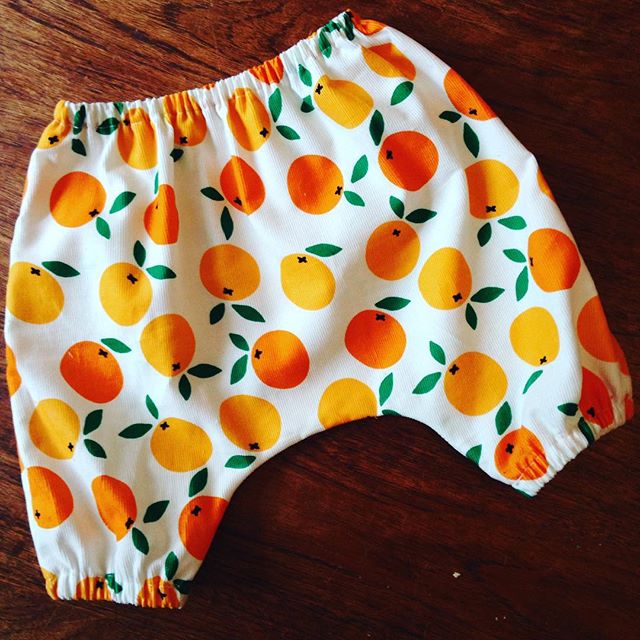
Now that we are firmly into autumn, I made these baby trousers in a delightfully soft needle cord in a fun print. After a couple of laps of the baby section in any department store, the parents will probably be very much over looking at pastel pink or pastel blue stuff, so this project really is your opportunity to pick something fun. The repetition of nappy and outfit changes will be brightened considerably if they are trying to clad that squirming little bottom in something that makes them smile. This needle cord also has the benefit of being made from 100% organic cotton by Cloud9 Fabrics, it’s called ‘Oh My Darlin’Clementine’ (https://www.thevillagehaberdashery.co.uk/small-world-oh-my-darlin-clementine) from the Small World range designed by Rae Hoekstra. The Small World range is comprised of fantastic, colourful, gender-neutral, perfect for this application. If you’d prefer a subtler look, this project would also work really well in these deliciously soft double gauze or striped or solid interlock knits.


The pattern I used was the Modern Baby Set by Green Bee Patterns which includes patterns for both trousers and nappy covers for babies aged 0-3 months. One of the awesome things about this pattern is that the front and back pieces are cut from the same pattern piece. Explain that to the new parents, then it’ll save them a lot of bleary-eyed attempts to figure out which way round the trousers or nappy cover goes during nappy changes. If you use a different trouser or nappy cover pattern that has front and back pieces that are different, then why not stitch a loop of ribbon into the back waistband so the back can be easily identified? Happy new-baby sewing, friends.

Tuesday, 5 January 2016

Sewing When You're Skint


Happy New Year!!! How exciting to be looking ahead to a whole year of sewing-based fun. And all the other types of fun. I don't know about you, but a new year always feels like a fresh start and I'm buzzing with excitement to get cracking on new projects. Except... No. Funds. Ugh! It's good to think about how we can get more from what we already own, sewing-wise and more generally, but it always seems more pressing at this time of year, doesn't it? I wrote a piece five years ago (WHAT?!) about cutting the costs of sewing, but here's some more ideas about how to get your sew-on if you're feeling the financial pinch at this, or any other, time of the year:

  • Comb your pattern stash. This one may seem obvious, but I think it's worth adding because it's easy to forget about stuff you already own. A couple of months ago I bought some new storage boxes for my sewing area so I ended up sifting through all my patterns and was amazed to find that I'd forgotten about over half of them! It really got my mind racing with possibilities and I have renewed excitement about finally making some of them up this year. Also, if you don't immediately print out your PDF patterns once you've acquired them, like most people I'd imagine, it might be worth trawling through the downloads folder on your computer to see if you've got some digital gems sitting in there. 
  • Refold your fabric. The beginning of a new year is a great time to take stock of your belongings and get things straightening out. It may seem a bit drastic, but if you get a chance, why not get your entire fabric stash out and refold everything? Unless you have some kind of permanent set-up where everything is neatly arranged and always on view, taking everything out is bound to unearth something you had forgotten you owned. I'm going to get all Marie Kondo on you now, but by handling your fabric through the process of sorting and folding means you'll be more likely to connect with each piece and either remember what project it was originally intended for, or perhaps you'll receive a zap of new inspiration for what it should become. Plus, having everything neat and in order (at least for a short while!) can have a great impact on flagging sew-jo. 
(a fabulous fabric swap that took place in Brighton four years ago!)
  • Hold or attend a fabric swap. Refolding your fabric will hopefully help you fall back in love with some of the pieces you've stashed, but finding some duds that you can't remember why you ever acquired in the first place is just as likely! You should find this second category of discovery almost as exciting as the first, because unwanted fabric, and sewing patterns for that matter, is currency. Find out if there is a sewing meet-up with a fabric/pattern swap going on that you can get to in the near future, and you can give the stuff that was languishing unloved a new loving home, whilst picking up something new-to-you that floats your boat. If you can't find anything already planned, why not try arranging a meet-up yourself? You'll probably make a heap of new sewing friends and have an ace time as well. 
  • Selling out. If attending or organising a meet-up/fabric swap isn't possible, selling those unwanted pieces of fabric and sewing patterns will get some funds flowing and make space for more appealing replacements! Jen from My Make Do And Mend Life's fabulous Top 5 Tips on Sourcing Secondhand Fabric post gives great ideas for how you could sell, as well as acquire, pre-owned fabric. 
  • Refashioning, remaking and upcycling. Using existing clothing as the basis for sewing projects is not only a great option for cutting down on the environmental impact of making clothes, but it's also freaking cheap! Whether you plunder a charity shop/thrift store/op shop for your starting point, or merely the cupboards in your own bedroom, it's got to cost less than heading to a fabric shop for your next sewing project. I've been harping on here on this blog about reusing unwanted clothes for yonks, but I feel that last year's Refashioners challenge hosted by Makery really breathed new life into the whole concept. So. Much. Creative. Awesomeness. If you've ever fancied having a whirl at refashioning, but weren't sure where to start, the community Pinterest board for the 2015 Get Shirty Refashioners challenge is packed with amazingness that might get your creative juices flowing. My Refashioning Project Ideas Pinterest board is also chock full of all manner of upcycling ideas that I personally found inspiring. 
  • Let the cat out of the bag. This one might take a bit longer to bear fruit, but it could be a fantastic way to open yourself up to heaps of free sewing stuff. Often we keep our passion for sewing to ourselves, especially if we work in a non-creative environment, or we are (sadly!) mixing with people who we fear may think that sewing your own clothes is a bit of a weird thing to do. But by occasionally sharing the fact that you love to sew with people that normally you might not tell, you are more likely to benefit when they hear of someone who wants to get rid of their sewing stash. People don't generally want to throw something in the bin if it might be used and loved, so even if the relationship link is really tenuous, you could be the one to luck out if somebody has decided to stop sewing, or they are clearing out the belongings of a relative or something. By making sure people knew I like to sew, I once received an enormous stash of buttons that I will literally never be able to use up and some great pattern cutting books from my ex-boyfriend's grandma's friend. I never met this women, but I made sure to send her a thank you card! 

So tell me about you! Are you feeling fired up, creatively speaking, at this time of year? Are you waiting for a payday/paid invoice to get back to piercing-fabric-with-needles?! Do you have any ideas for cutting sewing costs whilst on a budget?

Monday, 28 December 2015

Goodbye 2015, Hello 2016!!!


(pants self-sufficiency: my greatest sewing achievement?)

So, 2015, how was yours? Mine seemed to fly by, and in many ways I'm pleased to see the back of it. However, I feel is was a real success, sewing-wise. Here were my highlights:


  • Me-Made-May was bigger and more awesome than ever before! More people signed up to challenge themselves than any previous year, so that means awesome things for collectively developing better relationships with our handmade garments. As we all know, taking and sharing photographs of your outfits throughout May is NOT the what the challenge is all about, just the optional documentation of it, but as the most visible manifestation of the challenge, I found it interesting to note that participation via the Flickr board was down slightly this year, but Instagram was on FIRE with the #mmmay15 hashtag (and all the other hashtags that ended up being used!). In fact, the #mmmay15 hashtag clocked up over 13,000 on Instagram. That’s totally understandable of course, Instagram is sooo much easier to use than most sharing platforms, eh? MMMay also got some great non-handmade clothing community exposure too, most notably on the Huffington Post UK site, and hopefully we can build on that with even more next year. Which reminds me, I need to get a MMMay FAQ’s section up by next Spring.
  • Sewing for me: Aside from failing at my aim to nail trouser fitting, sewing for myself went very well this year. For the first time ever, I experimented with making a plan of forth-coming projects, and actually stuck to it (I still have two projects to go). From that, my sailboat raincoat has been the garment that has seen the most use so far. Oh, and I also became pants self-sufficient this year.
  • Sewing for Dolores: In 2014 I enjoyed sewing for Dolores more than sewing for myself. This year, it's been neck and neck. She has only just started to notice that she even wears clothes, let alone has an opinion on them, so it's been really fun to make whatever I like for her. I can use up small pieces of fabric, and use fabric that I love that I wouldn't wear myself. I can play with appliqués and embellishment, not worry too much about a perfect finish, and let's face it, small clothes look so cute! Taking part in the Kids Clothes Week challenges this year has been fabulous, and not surprisingly, the Upcycling edition was my favourite (explanation here and results here). 
  • Releasing my Anya shoulder Bag pattern: I found working on and releasing my latest sewing pattern, the Anya shoulder bag pattern, soooo fulfilling, despite the massive amount of hard work that was required! Seeing the testers' versions trickle in was one of the most exciting events in 2015 for me. It's been so fun that I've already begun work on my next two patterns...
  • The Refashioners: My goodness, the Refashioners challenge turned EPIC this year, didn't it?! So many sewing-blogger participants AND a community challenge that spawned some truly phenomenal shirt refashions. Fingers crossed, more sewers will consider making stuff from existing and unwanted garments rather than new fabric all the time, once they've seen all the amazing creativity that was on display. 

And 2016? I’m not going to make an extensive list of things to make and learn. I’m going to crack on with making whatever I want, using up my stash of fabric as much as possible, and making sure that each of my plans is likely to see years of wear. Of course I have many hopes and dreams for 2016 that are less directly related to sewing, but the only thing I will be making a commitment to myself to address is my sleep issues. As a long-time but intermittent insomniac, I have found that periods of bad sleep not only screw with your nighttime, but also effect pretty much every aspect of your daytime as well, which is really unfair! Your mood, your appetite, your energy levels, your patience,  your motivation, everything is so much harder, and it can feel so lonely when you're the only person in your household laying there awake. Again. Even though I know that there are probably hundreds of others experiencing sleep problems in the same town as me, let alone around the world.

Anyways, I wish you all a wonderful festive period, or at least a bloody good relax, whether or not you celebrate anything specific around this time of year. Thanks so much for reading my blog throughout 2015, and I promise more of the same for 2016! Love and best wishes to all xxx

Monday, 21 December 2015

Brightside Shrug


Kapow! There goes another project on my nippy weather sewing plans list. I've just made the MIY Collection Brightside shrug, and I've got these pics to prove it!


Pattern:

I'm always on the look out for a cardigan-type pattern that can be made in knit fabric so that I'm not wholly reliant on charity shops for my knitwear selection. I've recently started teaching classes at the MIY Workshop, so I've had the chance to get up close and personal with her product range (she has lots of lovely samples hanging up around the studio) and fell pretty hard for this simple shrug pattern. It's basically what I wish I'd been making when I made these reversible bolero shrugs (here and here) a few years back. Those ones felt a bit formal somehow, and they saw very little wear before I finally sent them to the charity shop. The Brightside shrug, however, feels way more comfortable and relaxed. 


The pattern itself is a very manageable three pieces: main body, neckband and cuffs. Even though I took care with the construction rather than rushing it together, and topstitched the seam allowances down, it still barely took an evening to put together. If you're in the market for a beginner-friendly/speedy cardi type pattern, this could be the one! It's available as a paper pattern as well as a PDF. Plus, if you're not sure about what type of fabric it'd work best in, or you struggle with sourcing  knits, Wendy has put together some awesome kits that include the pattern, a sufficient quantity of fabulous fabric to make it in and matching thread. Those kits would make a wonderful gift for a friend or relly that is getting into sewing clothes.

BTW, I made the size M for this shrug. The fit is fine, but next time I think I'll make a size L for a slightly looser, cosier feel. 


Fabric:

Maybe I was channelling Wendy's style when I went for a grey double knit for this project! Grey is a major element of her colour palette. Actually, the options in my stash were pretty limited, but luckily this gorgeously soft fabric would have been what I'd hoped to source if I went shopping for something suitable. It's been lurking in my stash for about four years, and I have no idea what the fibre content is because I got it second hand. In fact, I think it must have been a sample piece from a fabric or garment manufacturer because it has a perfect circle cut out of it, probably to add to a sample card somewhere. 

It would have been nice to have made this shrug in a super jazzy contrast fabric, and I'll certainly keep my eyes open for a suitable piece in red, jade, mustard or maybe even coral (or leopard or stripes) but I'm sure this grey version will fit right into my wardrobe and go with lots of outfits.  


Thoughts:

Although I work for MIY Workshop and MIY Collection are currently sponsors of this blog, I genuinely would have considered buying this shrug pattern anyway if I had discovered it in through different circumstances. Its speed of construction was a bonus, but what I really love about it is that it is really wearable. I'm just not interested in spending any sewing time on making stuff that won't see many, many wears, preferable for a number of years. 

Cost:

Pattern: £0 (I was given a copy to review, however it can be purchased as a paper pattern for £15, PDF pattern for £9 and as a kit with fabric and thread for £45)
Fabric: £0 (a stash lurker that I remember very little about the origin of counts as £0 round here!)
Total: £0

My favourite total cost for a project!  

Monday, 14 December 2015

Trouser Fitting Quest FAIL


At some point during the first half of 2015, I set myself the task of getting to grips with trouser fitting by the end of the year. No mean feat. In June I put a shout out for any suggestions of resources to help me with this and many of you left helpful comments. So, we now firmly into  December 2015, have I nailed trouser fitting? NO!!! Here's what's been going on....


I checked out most of the recommendations of books, websites and blog posts that were included in the comments of that post. I decided to buy Pants For Real People (pictured at the top of the post) and Sewing Pants That Fit (pictured above). When it arrived, the pleated front, super-loose 80s styles in the Sewing Pants That Fit seemed so far from the types of closer fitting trousers and jeans that I would like to make, that I questioned how much use the advice in that book would be to me so haven't given it much of a look yet. However, I did set about reading Pants For Real People pretty much cover to cover. 

Despite the Oprah-and-Ricki-Lake-era garment styles and photos, Pants For Real People seems to me like is contains most of what you'd need to be aware of when trying to fit trousers. Like it's equally fugly-but-useful sister, Fit For Real People, the authors are talking about tissue fitting a commercial sewing pattern to your body. I still believe that that is an insane waste of time, and cannot see why you wouldn't make a toile/muslin IN REAL FABRIC instead of trying to wear paper to find out what alterations you may need, but wharves. The advise about what fit issues to look for and how to adjust the pattern to avoid them is still put across really well.

So reading Pants For Real People may have led me to a false sense of security. I felt I was then left with two options of how to proceed. Do I, A) choose an existing sewing pattern that appears to be the kind of thing I'd like to wear, and then undergo a series of toile/muslin making and fittings? Or, B) do I draft my own pattern from scratch with my own specific measurements and then do the toile-making-and-fitting dance? I chose A).


Having recently delved into my copy of Gertie Sews Vintage Casual (pictured above) for the knit pencil skirt pattern and been very impressed, I went back and traced out the cigarette trousers pattern (pictured below), omitting the front slant pockets. They are effectively the type of trousers I'd like to make over and over again in fabric with a slight stretch, with different leg lengths and pocket details, so it seemed like a reasonable place to start.


I toiled up this pattern in the kind of fabric I'd be likely to make them in in the future (some gorgeous light/medium weight grainy stretch denim kindly given to me by the Fabric Godmother a while back). I hoped this pair would end up as vaguely wearable and they would show me what tweaks I'd need for perfected future versions. Armed with the toile, some pins, the Pants For Real People book and my mum for technical and moral support, we went in. Oh my, what a cluster fuck! They looked horrendous, and we just couldn't figure out why exactly or what to do about it. My mum and I spent a whole Dolores-nap-time (about 2 hours) inspecting, evaluating, pinching, pinning, shifting and referring back to the book and at the end of it, neither of us had the slightest clue what could be done to make the pattern wearable. I declared defeat and aborted the mission. I'll attempt to squeeze a pair of Hosh pants out of the ashes to salvage some of the beautiful denim, but emotionally I'm still pretty scarred from the debacle!


After all that, I wasn't sure how to proceed, and option B) was looking increasingly likely. Then Minerva Crafts emailed offering me a choice of sewing pattern and fabric to make it up in in exchange for a review. Seeing as what my wardrobe is still lacking in is a pair of decent trousers, I managed to tear myself away from looking at beautiful vintage-repro dress patterns, and focussed on find a trouser-pattern-and fabric-combo to have one more whirl at option A). After a lot of hunting through their overwhelmingly well-stocked website, I picked and received Burda 6811 (pictured above) and a sufficient quantity of black stretch wool twill suiting (which isn't shiny in real life like the pictures suggest). I've only got two projects left in from my nippy weather sewing plans, so I'll crack on with these trousers once those are in the bag and report back in due course...

Wednesday, 9 December 2015

How to Shorten a Zip


Here's a blog post that I originally wrote for The Daily Stitch, the Village Haberdashery's blog. Once again, they have been very kind and allowed me to re-post it here for those that didn't see it first time round. BTW, you can find the VH's range of zips/zippers here.  


The ability to shorten a zip is a very useful skill to have in your sewing-bag of tricks. Often a student will arrive at a class I’m teaching all stressed out because they couldn’t find the exact length zip that a sewing pattern called for, in the right colour for their project. My advice is always this: focus on finding a zip that is a great colour match for your chosen fabric. If the zip is a couple of inches too small, it’ll still probably be fine for your project, and if it’s too big then it can easily be shortened. If you type in ‘How to shorten a zip/zipper’ into YouTube, you’ll find heaps of videos on the subject. However, here is the method that I prefer…

Please note: this tutorial is for shortening regular or invisible/concealed zips with nylon teeth, not metal ones.


 Step 1: Find out how much shorter you want your zip to be.


Step 2: Place a pin where you want the new stopper to be. Alternatively, you could mark the zip tape with chalk or a marker pen.


Step 3: Put a strong needle in your sewing machine (I like to use a 90/14 needle for this process). Position the zip underneath your presser foot so that the needle is directly above the pin that you placed in the zip tape. Lower the presser foot so that the zip tape is clamped down and remove the pin.


Step 4: Slowly sew across the zip tape from one side to the other. It may feel a bit weird to do this, so use the hand wheel rather than the foot pedal if sewing over the zip teeth is freaking you out. But don’t worry, your needle is extremely unlikely to break!


Step 5: When you reach the other side of the zip tape, make sure the needle is piercing the zip tape (use the hand wheel if necessary). Then lift the presser foot, spin the zip round 180 degrees , lower the presser foot again and stitch back over the row of stitching. Do this three or four times to create a strong new zip stopper. 


Step 6: Remove the zip from your sewing machine and snip away any loose threads.


Step 7: Measure ½” below your new zip stopper and cut the excess away.


Step 8: Most zip shortening tutorials stop at this point, but I like to seal the bottom of the zip tape to prevent it from fraying. Quickly pass the cut edge through the flame of a lighter. I’m sure this goes without saying, but please take care using a lighter!


Done! A freshly shortened zip to your exact specifications, that won’t fray in the wash! 
Related Posts Plugin for WordPress, Blogger...