Showing posts with label how-to. Show all posts

Saturday, 2 July 2016

Five Genuinely Useful New Baby Makes #5: Knit Hat


Here’s the final (sniff) instalment of this legendary series of blog posts. I may well have saved the best for last as well. This project is insanely cute but it can be whipped up in the last half an hour before you need to leave for the baby shower! As with all these projects (check out the previous ones #1, #2, #3 and #4), it’s a chance for you to pick some fabric that reflects the style preferences of the parents (or just yourself!), rather than having to opt for the ubiquitous pastel pink or blue that’s found in most baby sections of a department store. I'd just like to thank The Village Haberdashery for allowing me to repost this blog post, as well as the others, over here. On with the tutorial…


Step 1: Cut a rectangle of knit fabric (we used the Andover jersey knits in Peony) 42cm wide X 38cm high.


Step 2: Fold the rectangle in half so that the shorter sides match up, with the right sides of the fabric facing each other. Pin round the three raw edges (there’s no need to pin the folded edge) whilst leaving a gap of approx. 6cm along one of the shorter edges (see the chalk marks in the image above).


Step 3: Stitch round the three edges where you just pinned with a 1cm seam allowance. Pivot at the corners so you get nice sharp right angles (see image above). Don’t forget to leave that gap!


Step 4: Trim away the two corners where you pivoted to within 2mm of the stitching.


Step 5: Turn the rectangle through the gap so that the right side of the fabric is now facing outwards. Use pin or something pointy to tease or poke the four corners out so they are nice and neat. By hand, slip stitch the gap closed.


Step 6: Push one of the short edges up inside to meet the other.


Step 7: Turn up the bottom edge to make a brim of approx. 4cm deep. Optional: make a couple of stitches at either side at the top of the brim to keep it in place.


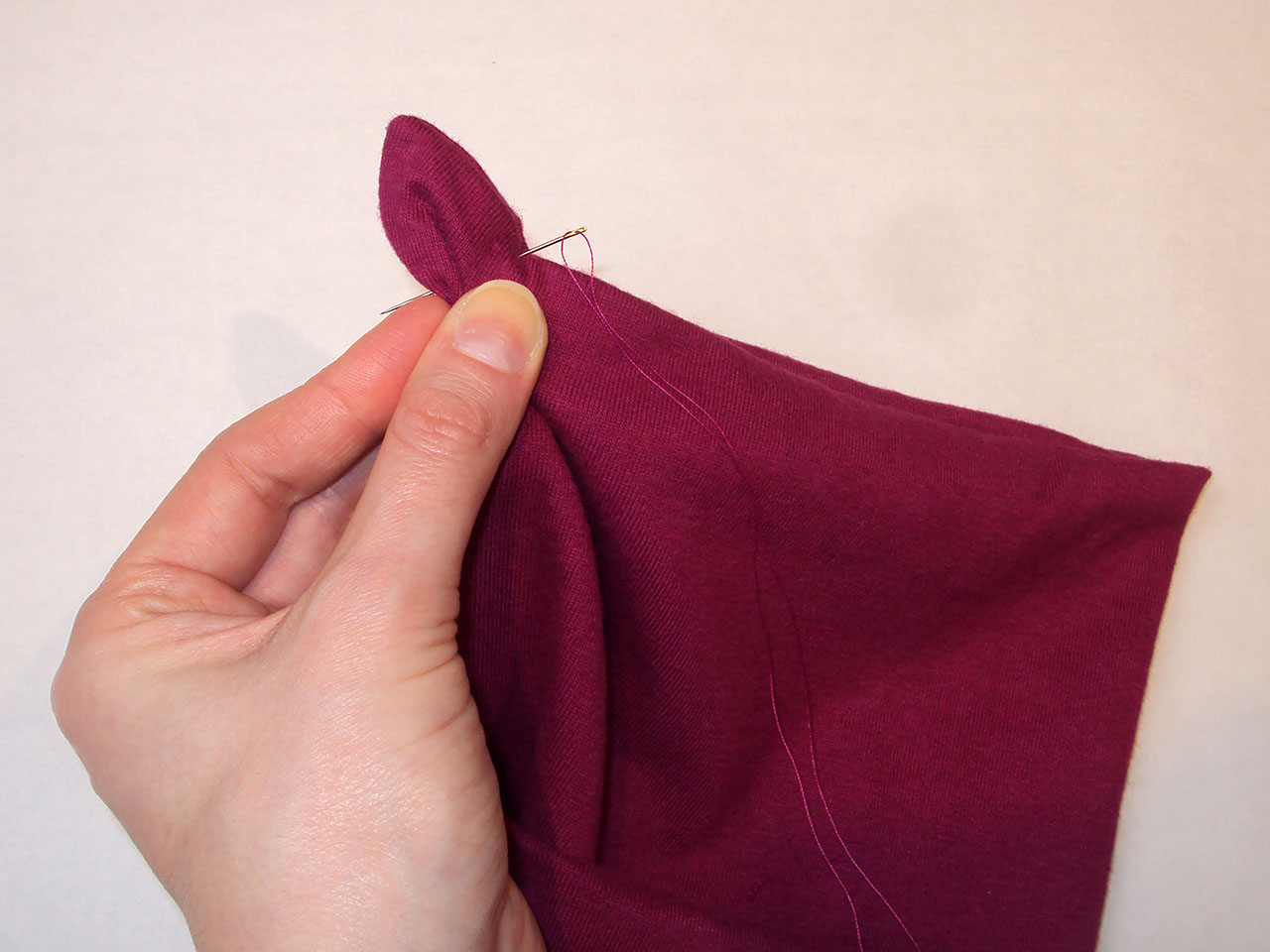
Step 8: Pinch each corner to make ‘ears’. Push the needle through each ‘ear’ (see image above) then wrap the thread tightly round it a few times before knotting the thread.


Ta daaaaaa! Now, quick, get to the baby shower or you’ll be late and there’ll be no cake left. 

Tuesday, 7 June 2016

Five Genuinely Useful New Baby Makes #4: Dribble Bibs


Now that the fun of Me-Made-May is over for another year, it's high time I got back to my mini series of blog posts offering ideas for those wishing to make some cute gifts for a new baba. This post first appeared on the Village Haberdashery blog 'The Daily Stitch'. Thank you to them for allowing me to repost it here. 

My fourth project suggestion is dribble bibs. These natty neck accessories are designed to catch some of the crazy-amount of dribble and small possets that will come from a baby’s mouth. These are not the same as the kind of bibs that babies wear to catch the mess when they start to eat solid foods at around six months of age. Dribble bibs are needed much earlier in the baby’s sartorial life and play a major role in cutting down the number of outfit changes the baby will require throughout the day. 

Why should you make dribble bibs? Because it may feel to the parent that, even if they owned all the bibs in the world, they still might not have enough. My daughter could get through eight a day when at her dribbliest, and in fact still wears one most days now she’s 2 years old. I’m going to show you how to make a cute neckerchief-style dribble bib that is both super-absorbent, and is adjustable in size so it’ll be useful for a long time. And once you get the knack of making them, you can set up a little production line and make a stack in different fun fabrics.

You will need:
Paper and pencil to draft a basic pattern
30cm knit fabric (jersey or interlock), which tends to be more absorbent than woven fabric (this rainbow plush jersey can be found here)
30cm medium weight cotton (brushed cotton/flannel are ideal), for adding body to the bib
30cm soft, fluffy fabric (micro fleece, toweling or velour), as a further barrier and feels nice if the bib touches the baby’s skin
matching thread
2 X press studs/poppers (poppers that attach with a clamp have been used here, but sew-on press studs are fine as long as they are securely stitched on)


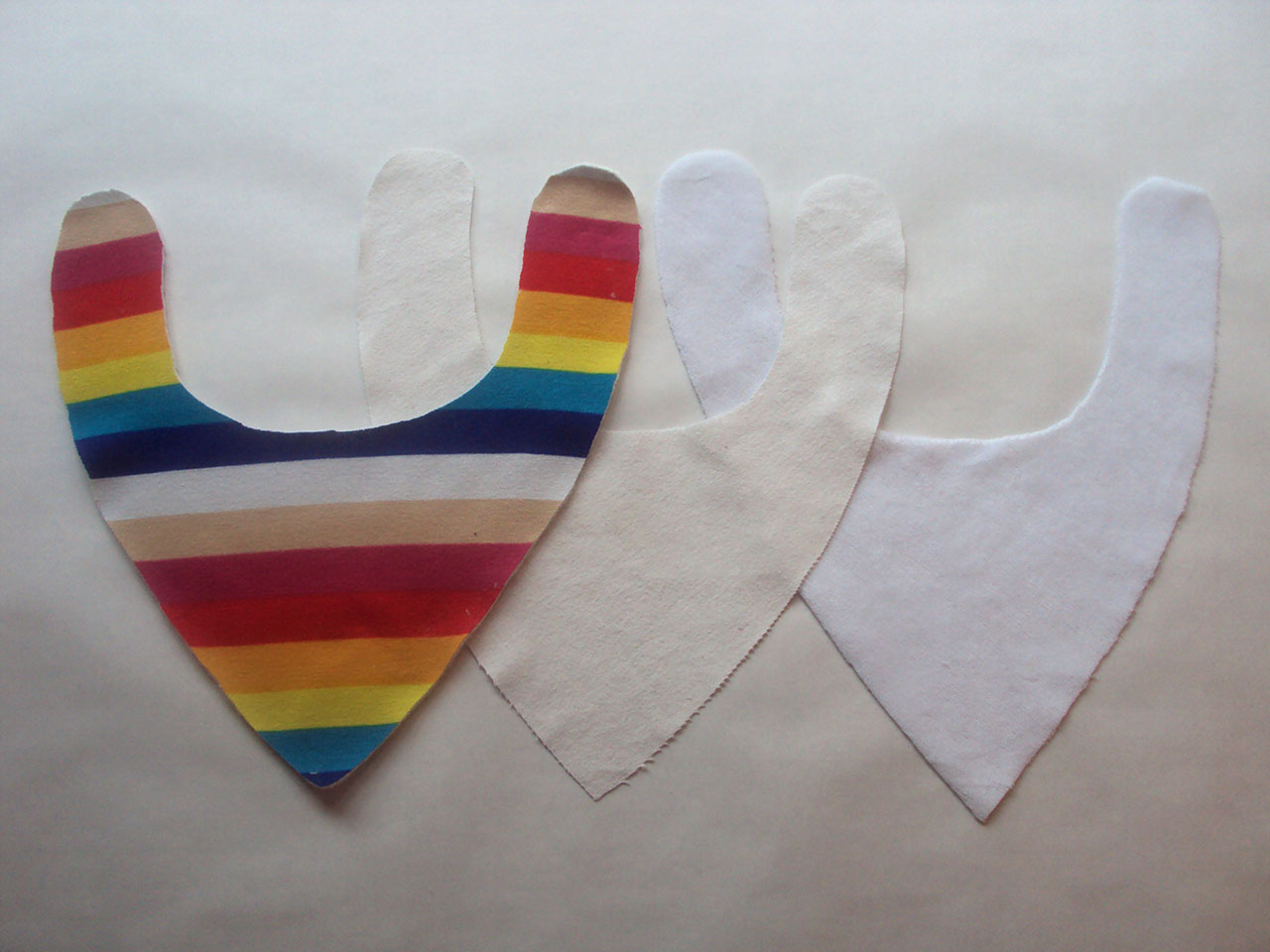
Draft a simple bib pattern shape like the one above. Mine is 28cm long and 12cm wide (which will be doubled when cut on the fold) including 6mm / ¼” seam allowance. (pic3)


Cut out three bib shapes on the fold:
1 X top layer in knit,
1 X middle layer in cotton,
1 X bottom layer in fleece, toweling or velour


Place the middle/cotton layer down on the table. Next, position the top/knit layer on top of it, right side facing up. Finally, position the bottom/soft layer on top of that, right side facing down. Pin the three layers together.


Stitch round the edge, leaving a gap of approx. 4cm / 1½” for turning the bib through. (PLEASE NOTE: I have used a contrasting coloured thread here for clarity, however it is advised that matching thread is used). Check that you have stitched through all three layers all the way round (excluding the gap). Re-stitch over any areas where one or more of the layers didn’t get stitched through initially.


Trim the seam allowance leaving 3mm / ⅛” all the way around, except at the gap. This is particularly necessary around the tight curves. Trim away the seam allowance at the point of the bib close to but not through the stitching. This reduces bulk inside the bib when it is turned through.


Turn the bib through so the knit fabric and the soft fabric are on the outside and the cotton layer is hidden inside. Use a pin to gently tease out the fabric at the point.


Tuck the seam allowances inside the gap and pin it closed.


Top-stitch round 3mm / ⅛” from the edge. Give the bib a press.


Apply two sets of press studs/poppers at the ends, 4cm / 1½” apart.


Ta dahhhh! One jazzy dribble-catcher complete.

Tuesday, 3 May 2016

Hand-Stitched #MMMay16 Badges By Tasha


If you are taking part in #MMMay16 and all the incredible handmade clothes being worn so far are getting you itching to make stuff, then may I suggest this awesome project that is the brain-child of challenge participant Tasha from Stale Bread Into French Toast? She has written a lovely explanation of what inspired the idea behind these gorgeous celebratory badges in this post, which also includes a complete explanation of how you can make your own, including a FREE PATTERNS PDF! Don't feel you need to have any previous hand-embroidery experience. Tasha takes you through the whole process, including useful info on materials and techniques, with beautifully clear photos for each step. 


Also, don't forget to enter the awesome Fabric Godmother 'Dream Wardrobe' giveaway if you haven't already and are taking part in #MMMay16. You have until Saturday night...

Wednesday, 9 December 2015

How to Shorten a Zip


Here's a blog post that I originally wrote for The Daily Stitch, the Village Haberdashery's blog. Once again, they have been very kind and allowed me to re-post it here for those that didn't see it first time round. BTW, you can find the VH's range of zips/zippers here.  


The ability to shorten a zip is a very useful skill to have in your sewing-bag of tricks. Often a student will arrive at a class I’m teaching all stressed out because they couldn’t find the exact length zip that a sewing pattern called for, in the right colour for their project. My advice is always this: focus on finding a zip that is a great colour match for your chosen fabric. If the zip is a couple of inches too small, it’ll still probably be fine for your project, and if it’s too big then it can easily be shortened. If you type in ‘How to shorten a zip/zipper’ into YouTube, you’ll find heaps of videos on the subject. However, here is the method that I prefer…

Please note: this tutorial is for shortening regular or invisible/concealed zips with nylon teeth, not metal ones.


 Step 1: Find out how much shorter you want your zip to be.


Step 2: Place a pin where you want the new stopper to be. Alternatively, you could mark the zip tape with chalk or a marker pen.


Step 3: Put a strong needle in your sewing machine (I like to use a 90/14 needle for this process). Position the zip underneath your presser foot so that the needle is directly above the pin that you placed in the zip tape. Lower the presser foot so that the zip tape is clamped down and remove the pin.


Step 4: Slowly sew across the zip tape from one side to the other. It may feel a bit weird to do this, so use the hand wheel rather than the foot pedal if sewing over the zip teeth is freaking you out. But don’t worry, your needle is extremely unlikely to break!


Step 5: When you reach the other side of the zip tape, make sure the needle is piercing the zip tape (use the hand wheel if necessary). Then lift the presser foot, spin the zip round 180 degrees , lower the presser foot again and stitch back over the row of stitching. Do this three or four times to create a strong new zip stopper. 


Step 6: Remove the zip from your sewing machine and snip away any loose threads.


Step 7: Measure ½” below your new zip stopper and cut the excess away.


Step 8: Most zip shortening tutorials stop at this point, but I like to seal the bottom of the zip tape to prevent it from fraying. Quickly pass the cut edge through the flame of a lighter. I’m sure this goes without saying, but please take care using a lighter!


Done! A freshly shortened zip to your exact specifications, that won’t fray in the wash! 

Monday, 12 October 2015

How To Make Your Own Bias Binding


Do you follow the Village Haberdashery's blog 'The Daily Stitch'? If not, maybe you should, it's very pretty. They've recently released some super exciting plans over there about their new premises and how you can own a little piece of the business. Well, anyway, if you do already follow The Daily Stitch, you will probably have already seen this post that is to follow as I've been doing a spot of guest-blogging over there. However, Annie has be insanely generous and allowed me to re-post my guest posts on my own blog for those who may not have already seen it. 

This is a simple how-to/tutorial for making your own bias binding. It’s such a fun thing to do, and really helps give your sewing projects extra personality and swankiness! The variety of pre-made bias binding available is pretty limited, plus I find that the usual stuff can be pretty stiff, which is not great for garment sewing in particular. Whether you choose to make binding that perfectly coordinates with your project, or that creates a bold or pretty contrast, your garment making and quilting projects can be elevated to something even more unique!

What You Will Need:

Selecting Fabric:


First you’ll need to select your fabric. If you plan to make coordinating binding, then you will just need to harvest some scraps left over from your cutting out. If you intend to make coordinating binding, then light-to-medium weight cotton (like quilting cotton or shirting) is ideal. There are a couple of things to consider if selecting printed fabric. Keep in mind the scale of the print; it has to be a small design to show up well on a narrow strip of binding. Striped fabric can be fun when made into binding, but it can create an extra challenge if you attempt to make the joins unnoticeable.

In terms of quantity, we’ll be making the binding from diagonal strips of your fabric, so try to find some scraps that can be cut into decent length strips to save you from having to make lots of joins. If you are buying fabric specifically for making bias binding, a fat quarter should be ample.

How to Make Bias Binding:


Give your fabric a press and lay it flat. Position your set square, pattern master or ruler so one edge is at a 45 degree angle to the selvedge or your fabric (see picture above). Many set squares and pattern masters have a 45 degree angle line printed on them or are a triangle shape (like the one I’ve used here), so it is easy to find. However, if you do not have a set square or pattern master, no problem! Eye-balling a 45 degree angle will be fine, or if you prefer to be more accurate and still have the edge cut across the width of your fabric, bring the cut edge so that it lays on top of the selvedge, then press down on the fold you have made. When you open it out again a crease should have formed at the 45 degree angle required.

Use a marking tool to draw along the 45 degree line, then cut along it. If you have a rotary cutter and cutting mat then you can use these straight away and eliminate the need to draw a line on your fabric.


Time to decide how wide you want your finished bias binding to be. Think about what width you want the binding to be when it has been sewn round the edge or your project, then times that by four (X 4) to figure out how wide the bias strips will need to be cut. In the example photographed, I wanted the bias binding to be 1cm wide when sewn, so I made the bias strips 4cm wide.

Use a ruler and marking tool to draw another line that runs parallel to your bias cut edge, at the width that you just calculated. If you have a set square or pattern master that has lines printed along one edge, this can help you mark the correct strip width quickly. Cut with scissors or a rotary cutter.


Continue cutting strips until you feel you have more than enough to bind the edges of your sewing project. It may sound obvious, but it’s better to make too much bias binding than end up with not quite enough, so if you can, cut a couple of extra strips than you feel would be sufficient.


Now you need to join the strips to form one continuous length. Start by laying the ends of the strips on top of each other perpendicular with right sides together (see above).  The strips will be stitched together at a 45 degree angle (more 45 degree angles!) so pin the strips accordingly and mark the stitching line if you wish (see above). Stitch the joins.


All your strips should now be attached to each other with joins resembling the picture above.


Trim away the excess seam allowance at each join leaving about 1cm.


With your iron set at a temperature suitable for your fabric (test on a scrap first!), press the seam allowances open at each join. Trim away the little triangles of seam allowance that extend beyond the edges of your strip.  


Give each join another press from the right side to make the long strip extra flat.


Fold and press your strip in half lengthways. 


Open the strip again so you can see the crease that has been formed along the centre. Bring the top edge to meet the centre crease and press.


Bring the bottom edge to meet the centre crease and press.


Give your bias strip one more press from the right side and you’re done. TA DA! You have made your own beautiful bias binding!!!!!
Related Posts Plugin for WordPress, Blogger...